
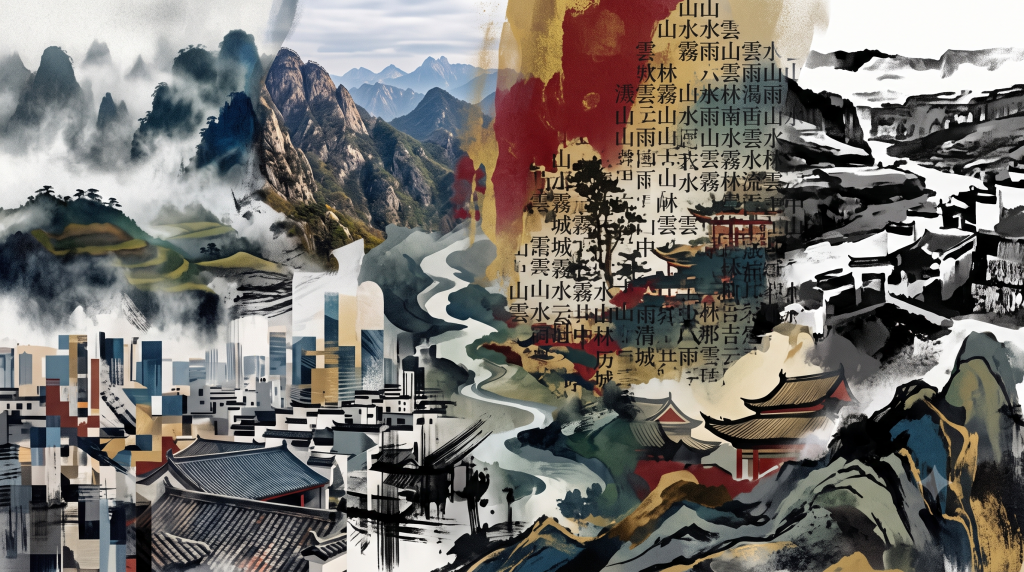
Algorithmic Ideation and the Fabricated Horizon
In an era dominated by social media curation, the camera is no longer a tool for documentative recording; it is an engine of hyper-real synthesis. We constantly edit, filter, and sanitize our surroundings to conform to internal fantasies, platform algorithms, or cultural expectations.
InstaAether addresses this universal impulse to manufacture an “idealized” reality—taking contemporary China, with its hyper-urbanization, iconic rural landscapes, ancient traditions, and dense digital ecosystem, as its primary canvas. By building a suite of specialized image-processing, Computer Vision (CV), and generative applications, InstaAether weaponizes mobile code to interrogate the tension between physical environmental reality and curated aesthetic expectation. It asks: What happens when software gives us total authority to “correct” and transmute physical space?
The project operates across three primary vectors: Spatial Hygiene & Anonymization (sanitizing clutter and masking human identity), Idealized Topography & Chromatics (manipulating atmosphere, perspective, and value mapping), and Algorithmic Transmutation (translating spatial imagery into fluid code, calligraphic brushwork, and topographic cartography).
I. Spatial Hygiene & Anonymization: Sanitizing the Public Sphere
The first group of applications explicitly addresses the impulse to cleanse physical space and human presence, exposing how mobile software allows us to treat public environments as sterile, hyper-curated stage sets.
- TouchEdit — Selective Erasure & Isolation
- Mechanic: Interactive point-prompt isolation to highlight, blur, or eliminate specific objects, bystanders, or unwanted infrastructure.
- Critique: Comments on the performative individualism of social media travel photography. By allowing the effortless removal of visual clutter, it critiques how public heritage sites are treated as private sets, and how local inhabitants or modern infrastructure are edited out as inconvenient “noise.”
- DeTract — Whiteout Erasure of Urban Distractions
- Mechanic: Uses object-detection models to automatically detect urban distractions—such as pedestrians, vehicles, and temporary street clutter—and overlays stark whiteout shapes over them.
- Critique: Where modern photo tools attempt to seamlessly “heal” or fill in removed objects to maintain a seamless illusion, DeTract leaves the act of erasure deliberately visible. By replacing people and vehicles with stark white voids, it exposes the aggressive nature of spatial hygiene, highlighting the absurdity of stripping human life from urban spaces to achieve an empty, ideal city.
- Maskera — Anonymization through Allegorical Archetype
- Mechanic: Detects faces in photographs using facial-recognition pipelines and composites dynamic Peking Opera masks (Lianpu) over them.
- Critique: Interrogates facial surveillance and social media identity culture simultaneously. Instead of applying neutral blurring or modern privacy masks, Maskera forces individuals into historical allegorical roles (e.g., heroes, villains, tricksters). It comments on how digital platforms reduce unique individuals to curated social caricatures, while offering a theatrical shield against algorithmic facial recognition.
II. Idealized Topography & Chromatics: Manufacturing the Landscape
The second group intervenes in atmospheric conditions, structural perspective, and color profiles—bending geographic reality to align with classical aesthetic tropes or formalist photographic rigor.
- Mistify & Clarify — Atmospheric Control
- Mechanic: Mistify introduces synthetic atmospheric mist into clear landscapes , while Clarify strips away haze, smog, and mountain fog.
- Critique: These twin tools critique the commercialization of nature. Mistify satisfies the romantic craving for a timeless, pastoral Jiangnan water-town aesthetic by hiding modern concrete under digital fog. Conversely, Clarify acts as an engine of visual cleansing, stripping away industrial pollution or regional humidity to enforce a pristine, hyper-clear tourist vista.
- Archalign — Orthogonal Authority
- Mechanic: Corrects keystoning and perspective distortion, forcing architectural lines into rigid vertical and horizontal parallelism.
- Critique: Exposes the desire for structural control and architectural-render perfection. By flattening organic, human-scale streetscapes into pristine geometry, it comments on how social media grids demand pristine visual order over lived structural reality.
- Zonal & Pigmentum — Value and Color Regimes
- Mechanic: Zonal remaps exposure strictly across Ansel Adams’ Zone System scale , while Pigmentum maps color palettes directly onto traditional Chinese mineral and vegetal pigments (e.g., azurite, malachite, cinnabar).
- Critique: These applications explore how value systems legitimize imagery. Zonal subjects casual mobile snapshots to modernist Western photographic rigor , while Pigmentum overwrites standard RGB sensor profiles with heritage-coded color palettes—questioning how color carries national identity and digital nostalgia.
III. Algorithmic Transmutation: Re-Coding the Material Canvas
The third group moves beyond photo correction into structural translation, converting photographic light data into physical landscapes, calligraphic strokes, and generative kinetic art.
- PhotoTerrain — Luminance as Topography
- Mechanic: Analyzes the luminance values of a photograph and generates topographical contour lines, exporting the image as a topographical elevation map.
- Critique: Translates visual light directly into cartographic geography. By treating a photo’s light values as physical elevation (peaks of brightness and valleys of shadow), PhotoTerrain comments on how digital images colonize and re-map physical space, transforming casual snapshots into artificial landscapes that can be surveyed and measured.
- LiteratInk — Digital Literati Synthesis
- Mechanic: Converts static photos into algorithmic, stroke-based brush paintings (Shuimohua).
- Critique: Automates the philosophical, meditative tradition of scholar-official brushwork. By translating edge vectors and pixels into simulated ink dynamics, it asks whether spiritual essence (Qiyun) can be calculated by shaders, or if code itself is the new literati medium.
- Generative Art & Generative Animator — Pixelated Fluidity
- Mechanic: Generative Art applies pixel sorting, Kuwahara filtering, neon edge extraction, and glitch processing , while Generative Animator injects particle flows, vector ripples, and fractal shards into static images.
- Critique: These engines destabilize the snapshot as a frozen truth. By subjecting real-world scenes to algorithmic chaos or perpetual kinetic motion, they critique the platform-driven demand for continuous motion and visual engagement, exposing the fragile data matrix underlying every “ideal” digital image.
Collective Resonance: Software as the New Ether
Historically, the aether was conceived as an omnipresent element connecting the cosmos. In the contemporary digital age, algorithmic software is our new aether—an invisible, ubiquitous layer mediating how we perceive land, architecture, history, and human identity.
InstaAether demonstrates that the desire to “correct” or transform a photograph is never neutral. Whether adding mist to an industrial town , whiteout-erasing bystanders from a street , or turning facial data into traditional opera masks, every digital edit reflects a refusal to accept the world as it is. By putting these tools directly into the user’s hands, InstaAether lays bare the central anxiety of the modern visual landscape: a world where reality is merely raw material awaiting software correction.
