
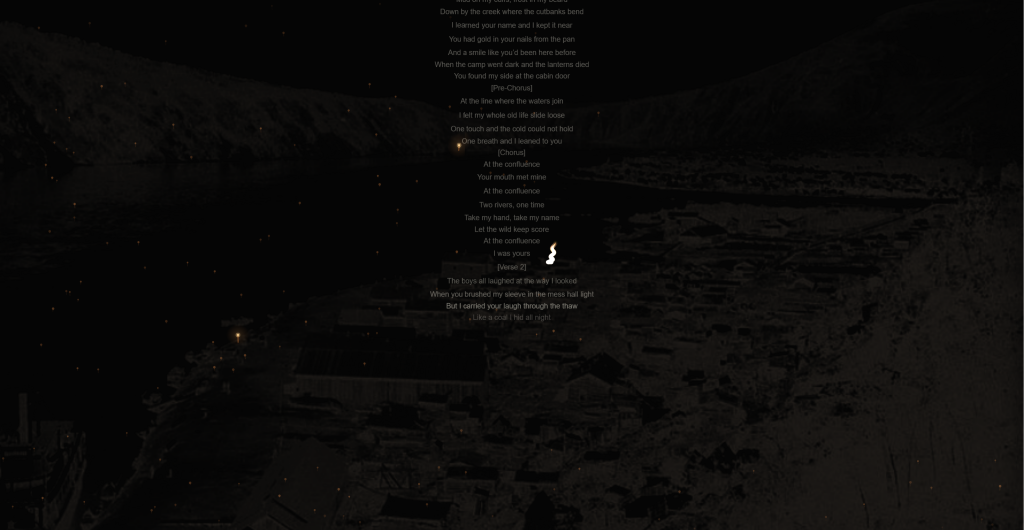
Gone Dyke Sparks transforms poetry written during the earlier Gone Dyke project (9 years ago) into a web-based musical sculpture composed of drifting embers, ash, and fleeting filaments of light. The work emerges from poetry written while traversing routes associated with the Klondike Gold Rush, where geo-located texts were composed from the perspective of a closeted queer miner moving through extraction landscapes, frozen terrain, transient camps, and overwhelmingly male social structures. Read about the earlier Gone Dyke project
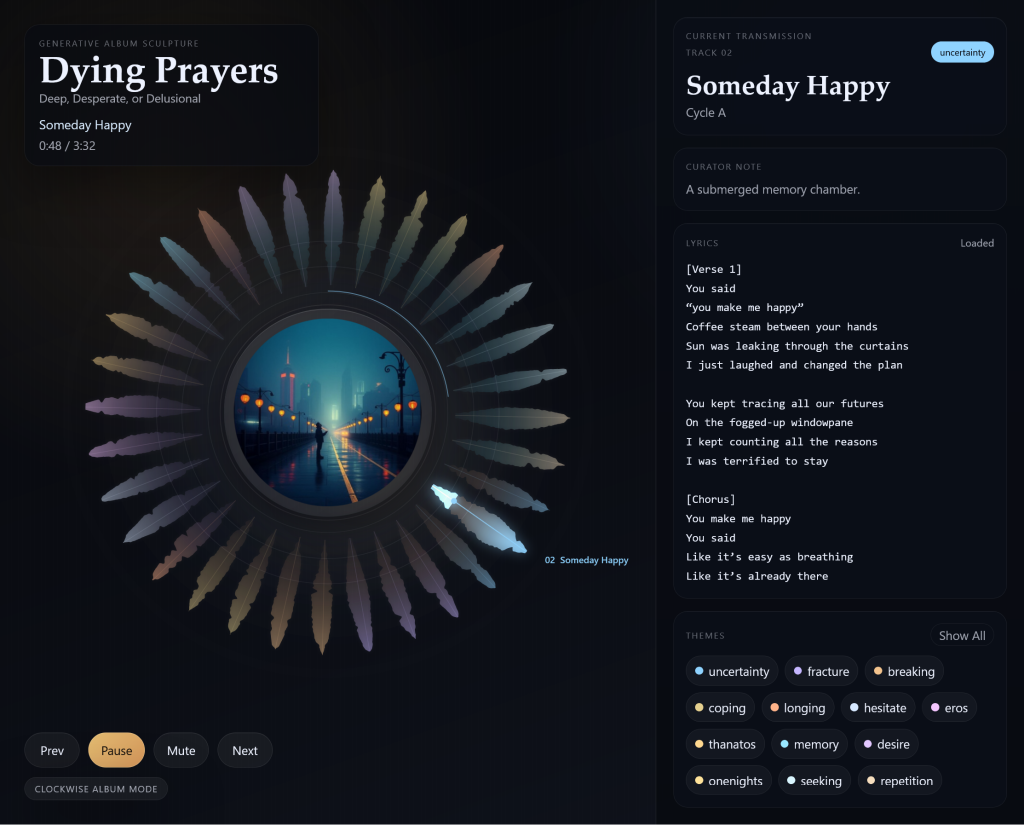
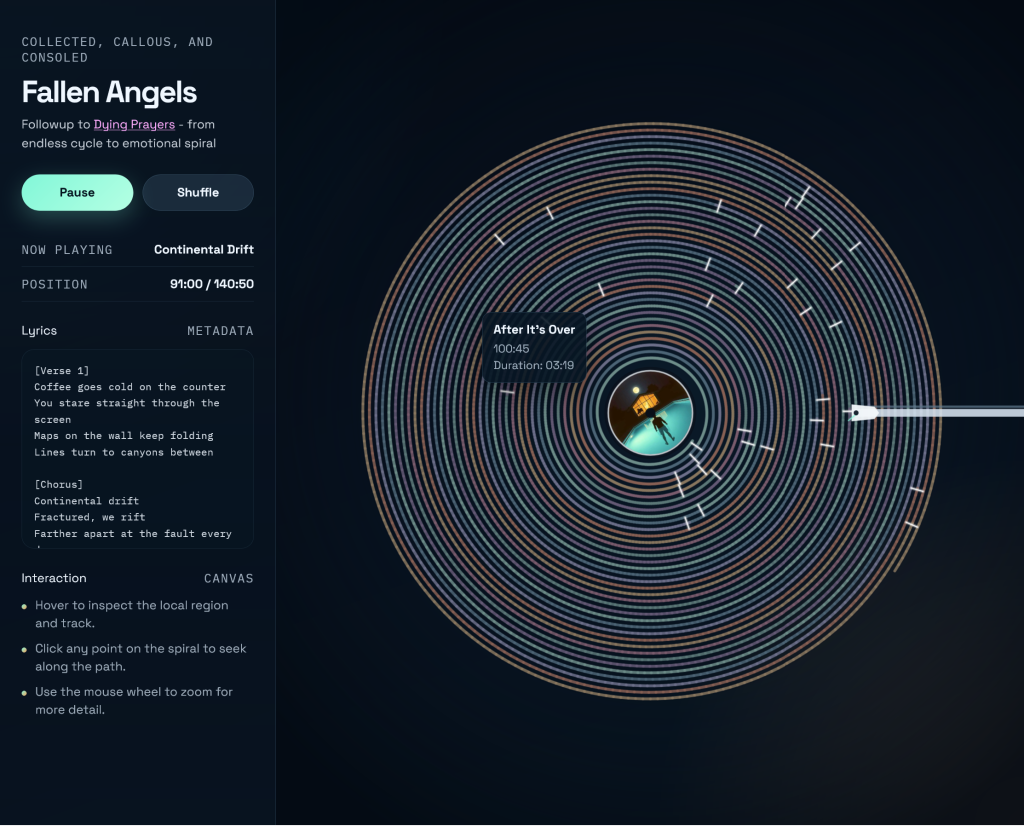
The impetus for Gone Dyke Sparks came after Stephen, exploring the boundaries of music generation, completed his personal album sculpture Dying Prayers earlier in the year, which transformed his Dying Prayers poetry anthology (written during an emotionally fraught period in his twenties) into very intense and personal songs. Each song was arranged as spokes around a rotating wheel evoking an endless cycle when the lyrical content comes full circle and recurs again. His followup album sculpture Fallen Angels, coincidentally completed on Stephen’s day of emancipation (based on his later Fallen Angels poetry anthology), takes the form of an emotional spiral evoking a LP record. These explorations and experiments formed the impetus for Gone Dyke Sparks, as a continued exploration of using AI generation to sing what is unsung, or cannot be sung.
The original poems from Gone Dyke were written as historical inhabitation rather than retrospective commentary. They attempted to reconstruct interiority within a world organized around hardship, mobility, labor, exhaustion, and masculine performance. Desire in that environment could not stabilize into open identity. It survived instead as concealment, coded gesture, passing intimacy, rumor, silence, or displacement into landscape itself.

When these texts were later transformed into songs using generative AI systems, an unexpected phenomenon emerged. Despite explicit prompting that the songs were to be sung by a male Klondike miner, the models repeatedly rendered the material in female voices. The system persistently associated the emotional texture of the lyrics—their vulnerability, yearning, tenderness, and intimacy—not with masculinity but with femininity. The project does not “correct” this misrecognition. Instead, Gone Dyke Sparks stages it directly.
The interface takes the form of a virtual campfire at night. No flames are visible. Instead, the screen is filled with drifting sparks and particulate ash rising upward through darkness. Most sparks fracture and disappear almost immediately, evoking the anonymous mass of miners moving through the gold rush economy: transient bodies consumed by extraction and historical disappearance. Among them, rarer sparks appear intermittently. These are the songs.
When selected, a spark arrests its upward drift and stretches into a tensioned filament whose duration corresponds to the playback of the track itself. The song temporarily holds the ember in existence. As playback progresses, the filament lengthens, strains, and ultimately snaps apart before fading back into darkness. The songs do not exist as permanent objects within the interface; they emerge briefly from the field and are reabsorbed into it.

Lyrics appear embedded within the same spatial field as the sparks rather than occupying a separate interface layer. Text drifts with controlled opacity among ash and embers, becoming temporarily legible before dissolving back into the visual atmosphere. The listener does not encounter the work through conventional playback controls or playlists. Instead, songs must be caught while they are still present.
The campfire structure invokes the social and material conditions of gold rush nights: temporary warmth, storytelling, exhaustion, isolation, and unstable forms of proximity between men living at the edge of survival. Within this environment, the queer voice appears not as declaration but as ember—briefly luminous, vulnerable to disappearance, and continually threatened by the surrounding field from which it emerges.

The project also reflects on how machine learning systems reorganize historical material through contemporary statistical associations. The AI’s insistence on female vocality reveals less about the historical miner than about the datasets and cultural mappings through which emotional expression is classified in the present. Vulnerability itself becomes gendered by the model. Gone Dyke Sparks preserves this displacement rather than resolving it, allowing the generated female voices to inhabit the miner’s perspective as a kind of temporal and computational misalignment.
The resulting work exists between historical reconstruction, generative error, musical memorial, and interactive environment. The interface does not attempt to recover an authentic queer past in stable form. Instead, it constructs a field in which queer expression appears intermittently against conditions of erasure, extraction, statistical bias, and disappearance—an occasional spark briefly visible within the dark.
CREATED BY: Stephen Chen | COMPLETED: 05/08/2026
Experience fullscreen: Gone Dyke Sparks
Click on (different) sparks as they emerge to play the associated song. Clicking on another (different) spark switches songs.
