A Quartet of Critical Creative Coding / Software Art
Modern software environments do not merely reflect physical space, language, landscape, or thought—they actively regulate how we inhabit them . From corporate productivity platforms and surveillance infrastructure to algorithmic statecraft and media curation, digital code functions as an architecture of control, flattening human experience into predictable, monetization-ready data streams. t : The Algorithmic Unraveling (TAU)—encompassing SynthesAsia, de-Note, InstaAether, and CunningLinguist—is an expanded quartet of tactical mobile application suites designed to rupture this managed existence.
By turning the smartphone’s sensors, camera, display, and processing power against their intended administrative functions, TAU weaponizes software to reclaim individual agency across four core vectors of perception: acoustic space, textual authority, visual hyperreality, and literary consciousness .
τ / TAU as
Resistance, Response, and Disruption
The title The Algorithmic Unraveling yields the acronym TAU (τ), a resonance that anchors the project’s dual critique of technological control and digital pathology:
The Physics of Reaction: Tau ($\tau$) as the Critical Time Constant
In physics and systems engineering, the Greek letter tau (τ) denotes the time constant—a metric quantifying how rapidly a system responds to a sudden disturbance or step change before reaching equilibrium. In modern platform capitalism, state surveillance, and algorithmic curation, corporate engineers optimize systems for an infinitely small τ: instant censorship, immediate keyword scrubbing, automated image filtering, and real-time behavioral nudging.
TAU re-appropriates this temporal metric as an engine for tactical latency and disruption. Instead of allowing automated algorithms to instantly smooth over social friction, software can deliberately inject lag, introduce ambiguity, and alter reaction times. TAU uses the time constant not to enforce rapid equilibrium, but to stretch the gap between input and system response—providing a critical window for human intervention, reflection, and subversion.
Biological Pathology: Tau Proteins and Algorithmic Neurosis
In neurobiology, tau proteins are vital molecules tasked with stabilizing the internal microtubule tracks of brain cells. When tau becomes hyperphosphorylated or misfolded, it detaches, forming tangled toxic clumps (neurofibrillary tangles) that break down cellular transport systems, corrupt memory pathways, and lead to cognitive collapse.
In the contemporary digital landscape, state and corporate software acts as a hyper-rigid tau protein—attempting to lock the “microtubules” of human thought, language, landscape, and sound into unyielding, standardized tracks. Yet ironically, this obsession with total structural order breeds its own digital pathology: memory loss through algorithmic erasure, cultural amnesia via curated state histories, and systemic anxiety induced by social media hyperreality . TAU deliberately “misfolds” the strict rules of mobile software engines. By corrupting database schemas, generating homophonic gibberish, redacting state slogans, and distorting camera shaders, TAU induces a productive “neurosis” within the surveillance apparatus—tangling the tracks of automated moderation to preserve human memory and authentic dissent.
Impetus:
The Friction of Travel and the Architecture of the Grid
The immediate impetus for TAU stems from the sensory and cognitive shock of navigating contemporary China—a landscape that operates as a crucible for 21st-century digital totalization. Upon entering this environment, the traveler’s standard digital apparatus instantly disintegrates: conventional Western applications fail behind the Great Firewall, severing expected flows of navigation, communication, and information.
In their place, one is forced to wrestle with an alien digital ecosystem—super-apps, opaque user interfaces, ubiquitous QR-code gateways, and frictionless mobile paywalls that condition every physical step. This digital friction highlights a profound contradiction in the global imagination: China is simultaneously projected as a hypermodern tech-dystopia (high-speed rail corridors, automated facial-recognition gates, smart-city grids) and an exotically ancient, timeless monolith (misty mountain passes, scholar-official gardens, classical scroll aesthetics).
This quartet emerges from the immediate, lived experience of that duality:
- Navigating high-surveillance urban centers where public space is intensely monitored, broadcasted, and sanitized .
- Experiencing the absurdity of Western and domestic platforms alike commodifying this terrain into sanitized, social-media-ready snapshots .
- Feeling the weight of real-time natural language processing and optical character recognition (OCR) scrubbing keywords, street signs, and images within milliseconds .
Rather than retreating into passive compliance or exoticizing the landscape from a distance, TAU responds directly to this friction. It treats the alienating software ecosystem of the journey not as an obstacle, but as a primary site of tactical artistic counter-intervention .
Critique of Creative Coding:
Beyond Spectacle and the Monopolized Instrument
In doing so, TAU explicitly breaks with the dominant paradigms of contemporary creative coding. Too often, creative coding has been co-opted into an engine for benign aesthetic spectacle—producing hypnotic particle fields, sleek reactive visuals, GLSL shaders, and audio-visual light shows designed for commercial galleries, corporate brand activations, or social media “coolness.” In this default mode, code remains a decorative veneer. It serves the visual economy by generating sterile, apolitical eye-candy that entertains without disrupting the underlying hardware, platform economics, or surveillance apparatus that hosts it.
This project rejects creative coding as mere ornament:
- From Visual Decor to Structural Sabotage: Where commercial creative coding uses algorithms to mask complexity with beauty, TAU uses algorithms to expose, stress-test, and sabotage the mechanics of digital control.
- Reclaiming the Interface: Instead of building passive visualizers, these apps intervene directly in real-time system pipelines—intercepting live microphone feeds, hijacking camera segmentation shaders, corrupting translation chains, redacting civic text, and manipulating location services.
- Interrogating the Medium: TAU asserts that writing code for art is an intensely political act. If software is being used by states and corporations to censor speech, map bodies, sanitize history, and extract behavioral data, then artistic code must act as a counter-grammar—a set of tactical tools designed to make systems illegible, ungovernable, and open to individual rewrite.
From the Closed Art Piece to the Democratic Instrument (Toolmaking as Tactical Art)
Crucially, traditional creative coding continues to operate under the romantic, authorial model of fine art: the programmer-artist writes code to produce a finished, closed art piece or site-specific installation created by the artist for passive consumption by an audience. The artist retains total control over the software tool, presenting only its output.
TAU fundamentally shifts the locus of creative agency by replacing the finished art piece with the democratic, tactical instrument. * The Artist as Instrument Maker: TAU does not present pre-packaged art objects to be viewed on a gallery wall. Instead, the artistic act lies in toolmaking—architecting open, mobile software instruments and placing them directly into the hands of users, travelers, activists, and the public .
- Distributed Subversive Agency: TAU operationalizes Jacques Attali’s concept of Composition—the democratization of the means of sonic and cultural production . By downloading TAU apps, any individual traversing a hyper-managed landscape becomes an active practitioner. A traveler on a high-speed train becomes an acoustic composer (Audroner, ChronoDrift) ; a pedestrian in a monitored square becomes a semiotic guerilla (SteleStrike, Censoreye) ; a social media user becomes a critical visual theorist (Maskera, DeTract) ; and a writer becomes a counter-canonical dramatist (StreamNotes, CineDraft).
- Participatory Resistance: Software becomes an extensible, participatory weapon. TAU transforms every smartphone into a portable factory of counter-narratives, ensuring that artistic intervention is no longer monopolized by the artist-coder, but distributed as an everyday tool of public resistance .
SynthesAsia: Destabilizing Acoustic Space
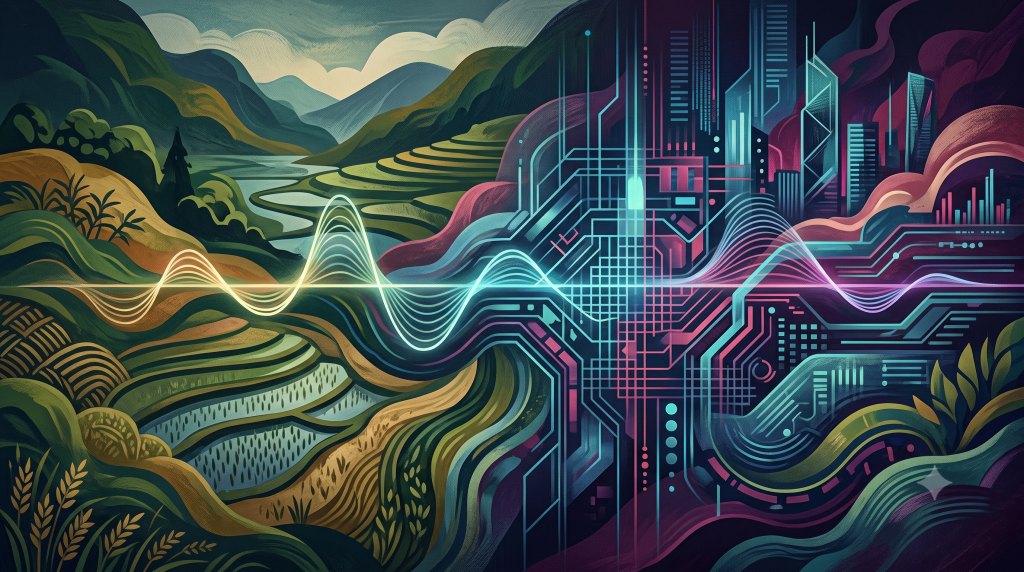
SynthesAsia addresses the managed soundscape—from the automated hum of high-speed transit corridors to commercial echo chambers. Drawing on Jacques Attali’s concept of Composition and Guy Debord’s dérive, the suite treats the urban traveler not as a passive audience to environmental noise, but as an active composer.
- Audroner: Captures real-time noise, slicing audio into granular, loopable DSP pads to strip regulatory signals of their authority .
- Sonic Weaver: Applies pitch detection to map urban chatter and sirens into musical scale notes, extracting latent logic from noise .
- SonicScape: Overlays dynamic synthetic weather over mic volume while geotagging the recording event .
- GeoMusic: Geofences local audio files to latitude/longitude coordinates, binding playback directly to territorial movement .
- SonicCam: Snaps photos overlaid with a real-time spectrogram of ambient noise, fusing visual topography with acoustic measurement to reveal hidden frequency pollution.
- ChronoDrift: Acts as a velocity-dependent sampler that warps and time-stretches ambient audio based on the user’s travel speed (e.g., walking vs. bullet train), commenting on accelerationism and the psychological collapse of distance.
de-Note: Subverting Textual Authority
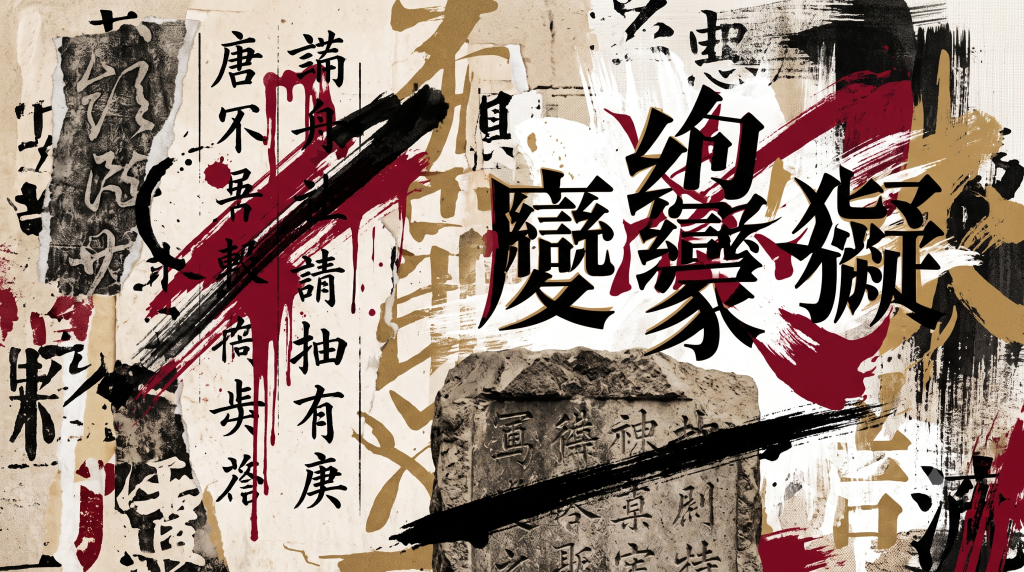
de-Note targets the ideological architecture of the logogram (hanzi), where written characters historically enforce statecraft, cultural orthodoxy, and real-time censorship . Grounded in Jacques Derrida’s deconstruction (sous rature and différance) and Roland Barthes’ semiotics, the suite uncouples script from state-sanctioned meaning .
- SteleStrike: Allows users to photograph stone monuments and digitally strike out carved characters, enacting Derrida’s sous rature.
- ConFoundry: Combines radicals to mint illegal, unutterable compound characters (reminiscent of Tangut script) to bypass dictionary databases .
- CharArt: Converts images into micro-text typography rendered exclusively from user-supplied banned poems or complaints .
- PoetryCalligraphy: Composites dissident commentary over classical landscape scroll aesthetics (shanshui), disrupting state-sponsored nostalgia.
- SinoDada: Takes Chinese text and replaces each character with an alternate glyph carrying the exact same pinyin and tone—preserving auditory cadence while reducing semantic content to Dadaist absurd nonsense.
- Censoreye: Scans photographs of street banners, official notices, and signage, automatically imposing redacted black boxes over buzzwords frequently used in state propaganda to generate real-world blackout poetry.
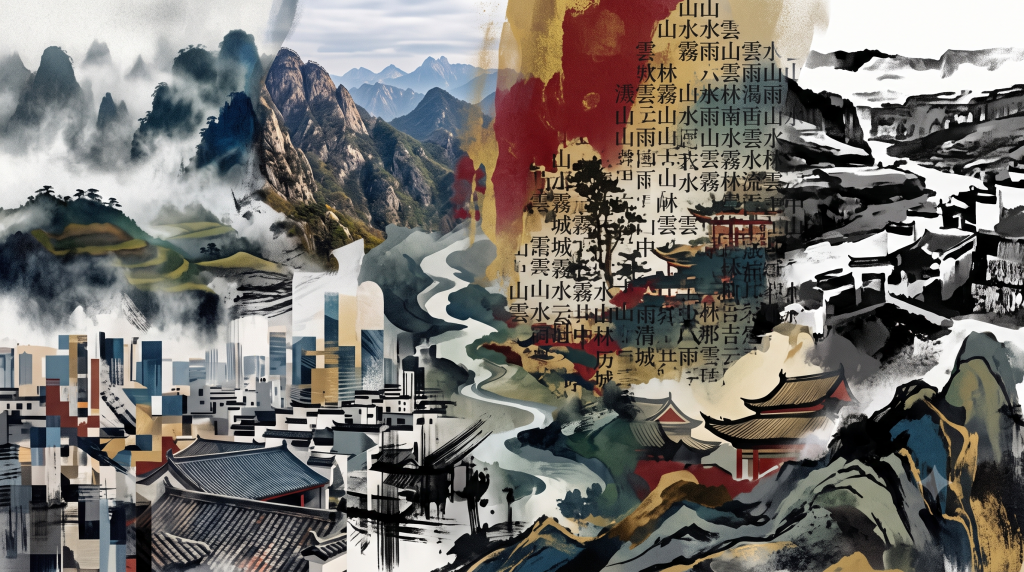
InstaAether: Exposing Visual Hyperreality
InstaAether critiques the universal human impulse to manufacture an idealized reality for social media consumption, using urban and rural topographies as a canvas . Operating through Jean Baudrillard’s theory of Simulacra and Simulation, the suite exposes how software mediates and replaces authentic space .
- Mistify & Clarify: Injects synthetic mist into mundane towns or dehazes urban smog over mountain ranges, exposing tourist hypocrisies .
- Archalign & TouchEdit: Straightens architectural perspective distortion and selectively hides or blurs unwanted crowds and migrant workers .
- Zonal & Pigmentum: Re-maps photographic luminance to Ansel Adams’ 11-Zone scale and shifts color profiles to traditional Chinese mineral pigments.
- LiteratInk, Generative Art & Generative Animator: Converts pixels into algorithmic brush strokes, pixel sorting, and particle vector ripples.
- Maskera: Leverages real-time facial detection to anonymize faces in photos by overlaying Peking Opera masks—archetyping identity and mocking facial recognition surveillance grids.
- PhotoTerrain: Extracts image luminance to generate and export topographic contour maps, turning social media snapshots into cartographic abstractions.
- DeTract: Detects urban “distractions” (pedestrians, vehicles, utility lines) and applies stark whiteout, laying bare the aggressive aesthetic sanitization required to construct hyperreal tourist imagery .
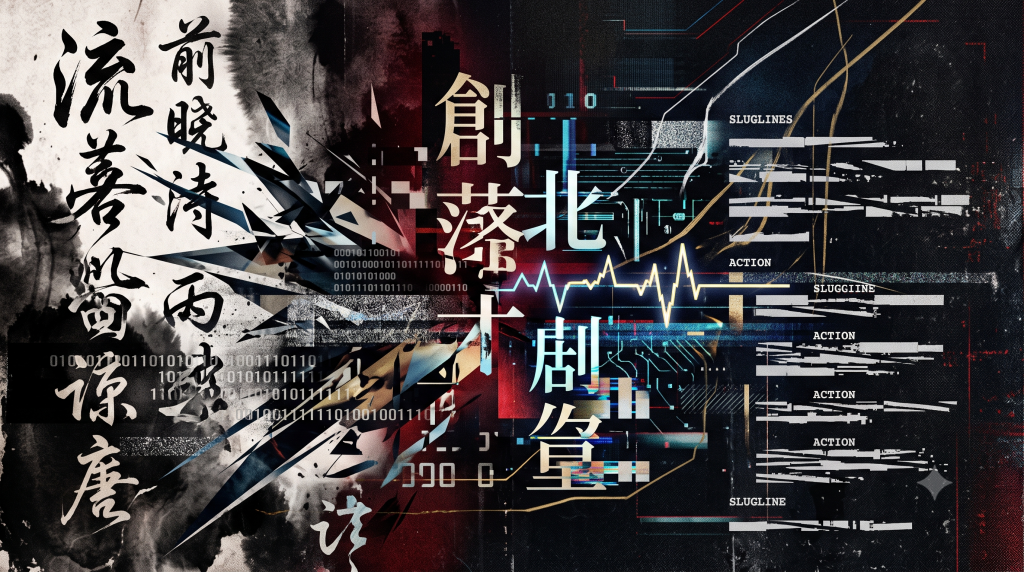
CunningLinguist: Liberating Consciousness
CunningLinguist dismantles the twin enclosures of productivity culture and imperial literary orthodoxy, both of which demand pre-categorization, rigid structure, and moral harmony. Utilizing natural language processing vector embeddings and spatial indexing, the suite bypasses the bureaucratic friction of software database schemas.
- StreamNotes: Captures open-ended stream-of-consciousness audio/text, delegating organizational indexing to vector embeddings.
- Fragmentry: Constellates raw poetic fragments into visual networks based on semantic vector proximity to spur complete poems.
- GeoNotes: Anchors notes and complaints to GPS coordinates, transforming physical geography into a living bulletin board of localized memory.
- CineDraft: A frictionless screenplay editor focused on rapid modal shifts between character, dialogue, and scene beats.
- VisiBored: An unstructured spatial vision board for images, documents, todos, and trackers—accumulating chaotic ideas that resist linear classification or immediate synthesis.
- ReTranslateDrift: Passes text through a recursive, multi-language translation chain (e.g., Chinese $\to$ English $\to$ Japanese $\to$ Chinese) to induce hermeneutic drift, corrupting literal meaning to reveal unexpected poetic resonance.
TAU as the Systemic Unraveling
In the final assessment, The Algorithmic Unraveling (TAU) operates as both a diagnostic tool and a cure. Where modern digital architectures attempt to enforce an immediate time constant ($\tau \to 0$)—demanding frictionless obedience, instant censorship, automated curation, and standardized thinking—this quartet insists on creating deliberate friction . Where state-sanctioned software acts as an unyielding tau protein, locking memory and expression into rigid ideological tracks, TAU misfolds the code itself, shattering the tracks to build alternative pathways of human agency .
TAU rejects both passive submission to technological enclosure and naive retreat into Luddite withdrawal . By deploying critical mobile software directly on the consumer hardware that mediates daily life, SynthesAsia, de-Note, InstaAether, and CunningLinguist prove that code need not function as a tool for efficiency, surveillance, platform monetization, administrative discipline, or decorative spectacle .
Most importantly, TAU democratizes this power: it shifts software art from closed, authorial art pieces into open, tactical instruments handed to others. It turns code into a distributed counter-grammar—a set of tools that allows every user traversing managed landscapes, writing within monitored networks, projecting curated images, and capturing fleeting thoughts to become an active author of their own aesthetic and political emancipation . The unraveling is not a breakdown of human consciousness, but the liberation of it: a deliberate, necessary unraveling of the digital grid to ensure that human expression remains volatile, uncensorable, and profoundly free.
CREATED BY: Stephen Chen | COMPLETED: 07/31/2026