
Semiotic Sabotage and the Subversive Logogram
Language is never neutral—it is an infrastructure of authority, memory, and social control. Throughout Chinese history, the written logogram has served as both an instrument of imperial statecraft and a tightly policed canvas of official truth. In the contemporary digital age, this power dynamic persists in real-time content filtering, algorithmic surveillance, ubiquitous state slogans, and automated censorship.
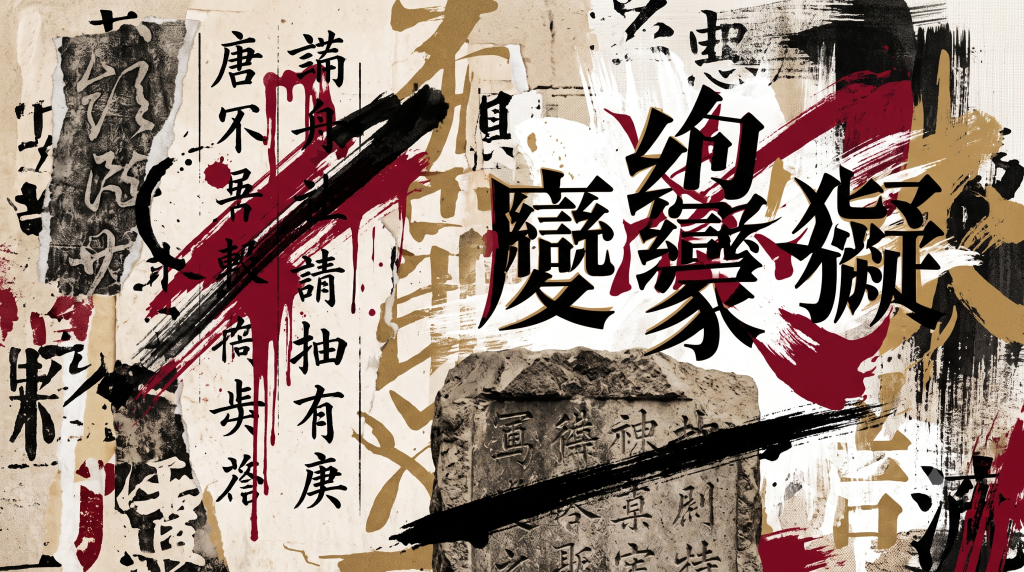
de-Note is an ongoing software suite and creative intervention that weaponizes code to reclaim Chinese characters as active sites of subversion, illegibility, blackout poetry, and dissent. By treating typography not as static text to be rendered, but as malleable visual and semantic raw material, de-Note interrogates how authority constructs legitimacy through the written word—and how code can disrupt it.
The project operates across two primary vectors: Iconoclasm & Evasion (desecrating official monuments, building machine-resistant scripts, and redacting state propaganda) and Linguistic Re-appropriation (re-purposing literati aesthetics and phonetics into hidden protest and Dadaist absurdities).
I. Iconoclasm & Evasion: Decentering Authority and Censoring the State
The first group of applications directly confronts state-sanctioned narratives, automated surveillance, and public propaganda—offering tools to deface, obscure, or blackout official text.
- SteleStrike — Desecrating the Monument
- Mechanic: Defaces and strikes through carved logograms within photographs of historical stone steles (bēilín).
- Disruption: Breaks the illusion of an unshakeable historical narrative and state-sanctioned permanence.
- Critique: Stone steles have historically functioned as the definitive state record—monuments carved to outlast human dissent. SteleStrike introduces a digital vandalism that acts as counter-memory, reflecting how online discourse constantly battles against “carved-in-stone” censorship to assert that no official history should remain immune to redlining.
- ConFoundry — Linguistic Mutation & Evasion
- Mechanic: Composites radicals and character components into complex, unreadably invented logograms—evoking the artificial complexity of Tangut script or modern “martian text” (hǔxīngwén).
- Disruption: Bypasses optical character recognition (OCR) and natural language processing (NLP) filters by rendering meaning opaque to algorithmic machines while remaining visually resonant to human observers.
- Critique: In a zeitgeist governed by automated surveillance, legibility is a vulnerability. ConFoundry celebrates illegibility as electronic defense, reclaiming historical strategies of radical script invention to build a machine-resistant vernacular.
- Censoreye — Blackout Redaction of State Media
- Mechanic: Uses object and text recognition on photographs of Chinese street signs, public text, and propaganda banners to impose redacted black boxes over high-frequency state media terms, policy slogans, and bureaucratic buzzwords.
- Disruption: Transforms public propaganda into visual blackout poetry, turning state-directed messages into sites of erasure and critique.
- Critique: State power relies on saturating the public sphere with ubiquitous slogans and ideological signage. Censoreye turns the tools of censorship back onto the state: by redacting official rhetoric from the visual landscape, it exposes the oppressive density of public propaganda while reclaiming space for alternative readings.
II. Linguistic Re-appropriation: Phonetic Absurdity and Stealth Discourse
The second group re-engineers traditional visual traditions and phonetic structures, converting elite art forms and official speech into vehicles for contemporary friction.
- CharArt — Pixelation as Protest
- Mechanic: Converts photographic imagery into ASCII-like visual art, rendered strictly through custom arrays of Chinese characters sourced directly from user inputs (such as forbidden poems, complaints, or manifesto snippets).
- Disruption: Collapses the distinction between text and image, hiding sensitive linguistic content in plain sight as purely visual pixels.
- Critique: CharArt speaks directly to “stealth discourse” under automated content filtering. By turning a protest or complaint into the literal structural pixels of an image, the app demonstrates how dissent adapts by embedding raw grievances into visual artifacts that circulate undetected.
- PoetryCalligraphy — Reclaiming the High Canvas
- Mechanic: Composites user-submitted text and modern grievances onto digital canvases mimicking traditional scholar-officials’ scroll paintings (shānshuǐ).
- Disruption: Hijacks the aesthetic of elite, high-culture literati calligraphy to host vernacular, raw, and politically charged text.
- Critique: Historically, scroll calligraphy was the domain of imperial elites who codified cultural taste and moral authority. PoetryCalligraphy democratizes this elevated medium, juxtaposing the serene, classical aesthetic of state heritage with the urgent complaints of contemporary lived experience.
- SinoDada — Phonetic Absurdity & Semantic Hollow
- Mechanic: Replaces every character in an input text with homophonic alternatives that share identical pinyin and tone values. The text retains its original spoken cadence, but its semantic meaning collapses into absurdity.
- Disruption: Subverts state-sanctioned slogans and rigid official rhetoric by preserving their outward phonetic shell while hollowing out their meaning.
- Critique: Chinese homophones have long been a weapon of online resistance (e.g., punning to evade censors). SinoDada weaponizes phonetics as Dadaist absurdity, echoing how official political slogans often sound harmonious and authoritative yet remain completely devoid of substance or truth in lived reality.
Collective Resonance: Code as Counter-Grammar
Together, the six applications within de-Note respond to a zeitgeist defined by algorithmic control, state-curated history, public propaganda, and the erosion of digital free expression. Rather than abandoning traditional logograms or state signifiers, the project uses software engineering to re-engineer, obscure, blackout, and deface them.
de-Note operates on a single premise: if code and state authority are used to censor, standardize, and dictate our words, then code must also be used to shatter, redact, and rebuild them. By transforming Chinese characters from rigid tools of statecraft into dynamic instruments of rebellion, de-Note asserts that language remains a living, contested battleground.
