
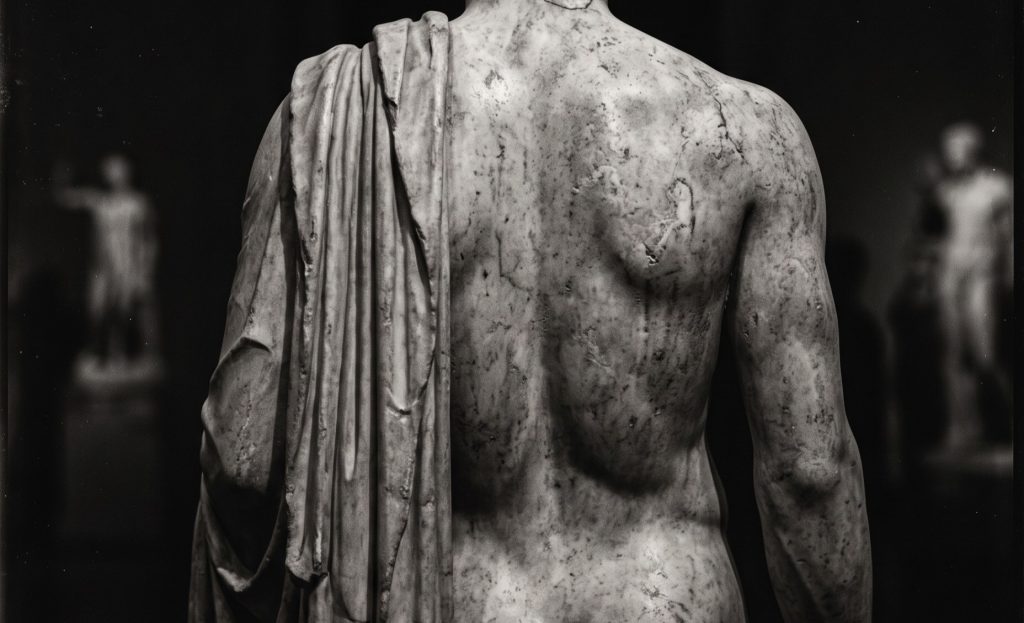
CONSTANTINE is an investigation into counterfactual cultural production: not what happens when an existing work is transformed into something else, but what happens when a work is made to occupy a history in which something that never happened appears to have happened.
The project consists of three albums—A Content Sin, Anti Consent, and As Continent—whose titles are permutations of the same word. Their shared letters establish a closed system in which each work contains the possibility of becoming another. The titles are not merely names but navigational structures: characters within one configuration become passages into the others.
The same logic operates at the level of the songs.
Each song begins with a poem that already exists. In A Content Sin, these are the erotic poems of C. P. Cavafy. In Anti Consent, they are my own poems concerning forbidden desire and missed encounters. In As Continent, they extend into poems of melancholia, loneliness and social incomprehension.
The poems themselves are not presented as objects of transformation. They are the fixed points of the counterfactual. What follows from them—lyrics and music—belongs to another ontological category. These are not adaptations of the poems, nor attempts to reproduce what the poet intended. They are artifacts of a history that did not occur: songs that might have existed had these poems entered my musical practice, but which, in the actual history of the poems, never did.
The musical system used to produce the recordings has been trained on my own singing and my own compositions, recorded when I was in my twenties and thirties. This introduces another temporal displacement. The poems of Cavafy concern, among other things, men in their twenties; my own poems were written more than twenty years ago, when I was myself in my twenties. The musical material through which both bodies of poetry are now given voice is likewise drawn from an earlier version of myself.
The resulting songs therefore bring several times into contact that never actually met: Cavafy’s young men, my younger self as poet, my younger self as musician, and the present in which these materials are computationally recombined. The question is no longer simply what if this poem were a song? It becomes: what songs might these poems have had if they had passed through a musical self that existed at another point in time?
The model is consequently neither a contemporary collaborator nor a neutral instrument. It functions as a temporal apparatus through which an earlier musical identity can be made to act upon texts that belong to different pasts. The recordings are new, but the voice and musical vocabulary from which they emerge are themselves archival.
This places the work in a peculiar relationship to history. Walter Benjamin’s conception of historical time attends to the unrealized possibilities contained within the past—to those futures that were possible but never became actual, and which may nevertheless remain active within the present. CONSTANTINE performs an inversion of this gesture.
Where Benjamin seeks to retrieve the unrealized from history, CONSTANTINE produces an artifact for the unrealized. There is no lost song here waiting to be recovered. No recording has been discovered; no forgotten musical setting is being reconstructed. The song never existed. Yet it now exists as an object. This produces a peculiar temporal condition. The recording is materially present, but the history it seems to presuppose is absent. Its existence does not establish the occurrence of the event that would have produced it. It is evidence of an event that never took place.
The distinction is therefore not between original and generated, nor between human and machine. It is between actuality and possibility. The songs are actual as recordings and counterfactual as histories. The interface preserves this distinction by withholding the source poems. The visitor does not encounter a before-and-after, and is not invited to measure the song against an original. Instead, the work presents the counterfactual object directly: a title, a body, a lyric, a voice.
Each album is grounded by a single male sculptural body. The body is not an illustration of any particular poem and does not change from song to song. It establishes a persistent corporeal field within which the counterfactual songs accumulate. Across the three albums, desire moves from the historically encoded eroticism of Cavafy, through forbidden and missed encounters, toward the more diffuse conditions of loneliness and social unintelligibility. The body remains while the possible histories around it change.
The three album titles themselves enact the same logic. A Content Sin, Anti Consent, and As Continent are permutations of CONSTANTINE: distinct configurations produced from the same underlying letters. The highlighted characters through which one album leads to another make this contingency literal. Each configuration contains exits into the others.
The title carries a secondary historical resonance in Constantine the Great: conversion, revelation, competing accounts, imperial reconfiguration, and the production of a new order from an unstable past. The reference is deliberately oblique. It does not provide a key to the work, but introduces another historical figure whose identity was itself consolidated through artifacts, testimony, interpretation and retrospective construction. CONSTANTINE therefore acquires one further layer of counterfactuality without requiring the analogy to be made explicit.
The title carries a secondary historical resonance in Constantine the Great: conversion, revelation, competing accounts, imperial reconfiguration, and the production of a new order from an unstable past. The reference is deliberately oblique. It does not provide a key to the work, but introduces another historical figure whose identity was itself consolidated through artifacts, testimony, interpretation and retrospective construction. CONSTANTINE therefore acquires one further layer of counterfactuality without requiring the analogy to be made explicit.
The project consequently operates across two kinds of possibility: the possibility contained within a poem, and the possibility contained within the system that surrounds it.
The first is poetic.
The second is historical.
But there is also a third: the possibility of a past self encountering a past that never belonged to it. Neither possibility needs to have happened in order to become materially encounterable.
CONSTANTINE is not an archive of what happened, nor a fiction of what happened. It is an attempt to give form to what did not happen—to produce the artifact that an unrealized history would have left behind.
