
It began with a well-meaning, if misguided comment, from a White person that I should pursue a MFA to work towards Documenta and Biennale. “Your ideas will jump to a different level if you were developing them in OCADU”.
And I thought “OCAD-ewww”
That comment reeked of White perception and valuation of coloured art and artists – how we are forced to work in White idioms, institutions and credentials for legibility and legitimacy. Our work is inseparable from White notions of display and selection, curated by White sensibilities for White sensitivities – operating through the White lens and frame of Minorities; similar to how our civilizations and cultures have been interpreted and consumed through White-biased academia lenses of archaeology, sociology, ethnography, politics, art history etc. as gestures towards diversity.
PROJECT IDEA
Since there is so much research and publications written by White people explaining our/other cultures to other White people since colonial times, I had the idea of creating a corresponding “White Studies” class for a university in a previously colonized country to explain White people and civilization to postcolonial peoples – one that debunks the heroic narrative of white progress / superiority and show how rooted it is in white insecurity and fragility. With class readings that situate canonical Western thinkers like Hegel, Adam Smith etc. that are taught ad nauseum, as part of weekly problematic – to encourage rereading them not as “timeless truth” but insecurity.
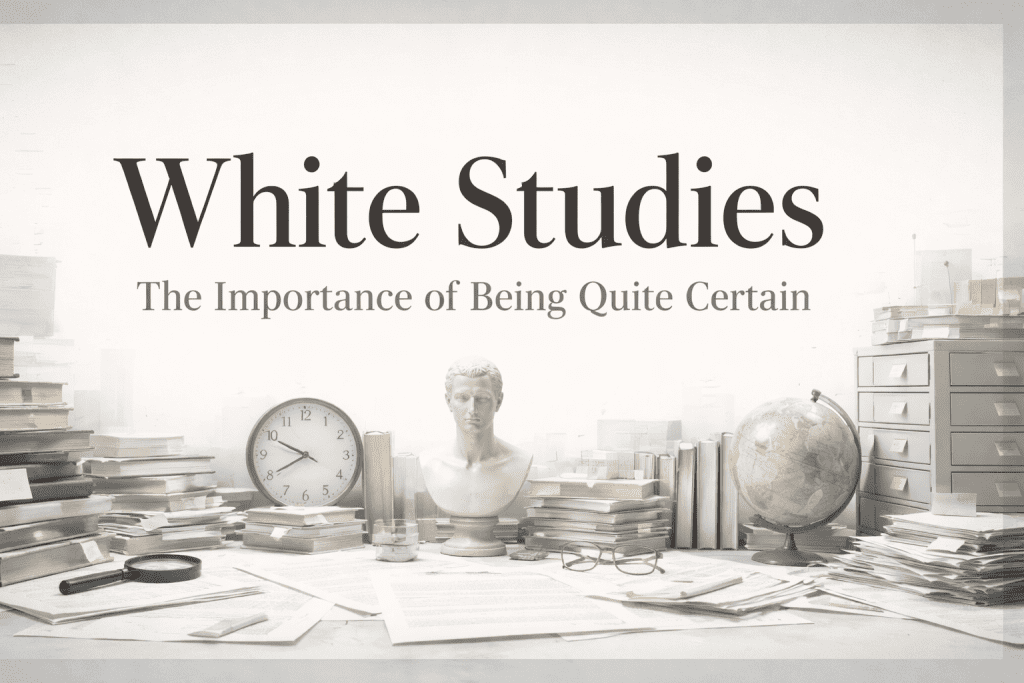
Go to White Studies: The Importance of Being Quite Certain: https://sites.google.com/view/university-of-samara/home
White Studies: The Importance of Being Quite Certain is a research-based installation and publication project that examines whiteness not as identity or ideology, but as a structural response to insecurity. The Importance of Being Quite Certain is not an argument against whiteness.
It is an analysis of how whiteness learned to survive by insisting it had nothing to explain.
The project begins from a refusal of the heroic colonial narrative. European expansion is commonly taught as confidence—technical superiority, rational governance, civilizational advancement. This project treats that story as misdirection, project approaching colonial modernity as a system built to manage fear: fear of contingency, difference, and being local. Universalism, neutrality, and objectivity are treated not as timeless truths, but as administrative solutions—technologies that stabilize authority by reducing negotiation and deferring accountability. They allow power to circulate without explanation. When these frameworks are challenged, they do not collapse; they proceduralize. Offense, grievance, consultation, and reform become substitutes for command.
It traces these patterns across multiple registers, working through misused institutional forms—archival lecture transcripts, diagnostic manuals, program charters, council minutes, and curricular materials—the project adopts the language of bureaucracy without parody. These documents do not accuse or persuade; they observe how certainty is produced, defended, and reproduced, particularly when it no longer believes its own claims. The tone is restrained. The forms are familiar. This is not parody. It is over-identification.
The project is framed through the fictional but historically plausible University of Samara (a university that could be situated anywhere in Africa, India, SE Asia), whose layered history of trade, colonial administration, independence, and post-colonial governance mirrors the epistemic conditions under examination. Samara is not presented as neutral ground. It is presented as an institution that has been repeatedly classified, standardized, audited, and aligned, and therefore cannot plausibly believe in neutrality as innocence. Situated explicitly from a post-colonial vantage point, it is addressed to students, artists, and audiences who have lived under imported certainty and have been required to translate themselves into its language.
The Importance of Being Quite Certain traces these patterns across multiple registers: archival lecture transcripts, diagnostic manuals, institutional histories, program charters, and curricular materials. The language is deliberately bureaucratic. The tone is restrained. The forms are familiar. This is not parody. It is over-identification.
Within this frame, White Studies is introduced not as advocacy or moral critique, but as diagnosis. The program does not ask who is guilty or who is harmed. It asks how certainty is produced, defended, and reproduced—particularly when it no longer believes its own claims. White insecurity and fragility are treated not as emotional states, but as institutional behaviors that appear at scale: in border regimes, development discourse, museums, universities, and global governance.
The work offers no solutions. It does not promise decolonization, repair, or closure. It operates on the assumption that contemporary institutions are highly capable of absorbing critique, renaming themselves, and continuing unchanged. Rather than opposing this capacity, the project renders it visible.
The Importance of Being Quite Certain is not an argument against whiteness.
It is an analysis of how whiteness learned to survive by insisting it had nothing to explain.
Go to White Studies: The Importance of Being Quite Certain: https://sites.google.com/view/university-of-samara/home
Artist’s Note
My work examines how authority speaks, how it stabilizes itself, and how it fails. I am interested in systems that present themselves as neutral: institutions, genres, administrative language, maps, archives, and increasingly, artificial intelligence. These systems claim objectivity while quietly shaping what can be seen, said, or remembered. Rather than opposing them directly, my practice studies how they operate—especially at the moments when their confidence becomes brittle. I am attentive to how systems persist precisely because they can absorb opposition, rename themselves, and continue.
In recent years, generative AI has become central to my work, not as a novelty, but as an amplifier of existing institutional habits. Models trained on aggregated culture reproduce authority voices with uncanny fluency. They hallucinate neutrality. They compress centuries of confidence into instantly deployable form. I use these systems deliberately, often constraining them, to expose how easily structure masquerades as intelligence.
This structure reflects the way institutional knowledge is often encountered: incrementally, repetitively, without resolution. By adopting familiar formats, the project invites recognition rather than confrontation. Viewers may find the language reassuring. They may also find it unsettling. Both responses are appropriate. The work does not instruct the viewer on how to feel or what to conclude. If the project appears restrained, this is intentional. Institutions are rarely transformed by opposition alone. More often, they are altered by subtle shifts in how their own logics are reflected back to them.
This work remains attentive to the conditions that make it possible. It acknowledges the support structures that enable its presentation. It understands itself as situated within, rather than outside of, institutional space. What it offers is not critique as spectacle, but attention as method.
