
There was an immense outpouring of creative energies after I returned from the West Coast. I spent hours each week in the darkroom printing out olf negatives, I put together, rehearsed and performed a 2 hour solo cabaret show “A-strange Love” (pun. estranged love) at a pub that distilled 15 years of heartache into an evening of anecdotes and torch songs, I even paired each of the 8 sets with drink recommendations so if you were thus inclined, you could get more drunk and more depressed as the evening progressed. After I finished, two guys in attendance whom I was dating at that time came up to me and broke up with me; “we would be better off as friends” or something to that effect. My last minute swap of “I am changing” (Dreamgirls) for “At Last” (Etta James) for my encore number was valiant but insufficient not to overlook my baggage.
Well, whatever. I was tired of suppressing myself for others; separating and hiding my art & expression The decades of unhappiness, and pent up unfulfillment erupted and from the ejecta my next goal slowly took shape and crystallized. Against the odds, I had hauled myself out of poverty despite workplace discrimination and exploitation and achieved my stated professional goal of running an Advanced Analytics division (or what would be termed “Data Science” or “Machine Learning” in today’s parlance. And I felt lost, I wondered what was next. Was I special or did I become less special. Did I accomplish a life less ordinary, or a lifeless ordinary? (Those same thoughts and words will wind up in the script for IN-DIFFERENCE)
I thought about my past dreams of writing the great novel, the great play, the great symphony etc. – some of which I had accomplished to some degree like photography, piano, and opera before realizing they were not environments i can thrive in and do the art I want to do. All these disparate pieces began to link together; together with my voice, my coping, music as source of expression, disdain for convention, my compositions, my poetry etc. formed an idea which tied my past, my present, my separation together to become STILLE STADT (Silent City); an experimental feature to depict the state of contemporary urbanity through an Everyman on the verge of a mid-life crisis, who goes through his life of routine both stricken and sustained by opera arias which stand in for his thoughts and emotions that only he (and the audience) can hear.
I will fill the hole in my heart with art. To make beautiful, to transmute pain is my purpose.
Stille Stadt & Rain Shadow
In between job interviews which led to nowhere, I attended workshops on grants, film budgeting, proposal writing, production insurance, etc. – all the things I thought I needed to know to put together and submit a grant package to arts funding organizations to make a film. There was always something happening every other day. In between, I wrote and rewrote the outline and draft script for STILLE STADT. I attended artist conferences and events, hoping to find like-minded comrades, but I quickly got weary of their self-indulgence and propritating pretensions. There is nothing mystical and rarefied about art and creativity, like they made it out to be, or the shit they make art out to be. Creativity/Art is no different than taking a dump – you never know a lot of it is coming out, or a little bit. At times you have to push real hard, at times it comes out easily. Sometimes what comes out stinks, other times you think you will die if it doesn’t come out. I don’t consider myself particularly creative (as it does not fit the common conception of creative), all my art stems from an expression of my life, an extension of my self. It’s a good thing I’ve had a terrible life.
An embarrassment of riches enough for a few soap operas. While drafting STILLE STADT, I watched “August” that was generating a lot of buzz at a Queer film festival with its depiction of a dysfunctional tortured abusive relationship. I laughed at the film – is that the level of dysfunction to be considered artistic? Holy Fuck, that is like a Wednesday night in my relationships. In reaction, I began drafting a treatment and fragmentary screenplay (“that accumulates like raindrops” as I wrote in my notes) based on my struggles living in the Pacific Northwest, my relationships and ended with my recent farewell to Erik, entitled RAIN SHADOW.
Still STILLE STADT was the film I wanted to make, an allegory of the suffocation of space, sameness and banality of ritual, conversation and status that had chained me which I was finally able to break from after the Gems route. I was never free to do as I pleased, bound by mental illness and consequences from my past (intense reactions when I was helpless to stop spinouts from happening), and relationships and jobs with no future. I had to redress, to rectify my neglect of my art and dreams in order to survive – not just some white middle class notion of finding oneself genteely, but a necessity inextricable from my condition and my coping.
Just as I was suffocated by fate and convention in Singapore, I faced another kind of suffocation in North America; another kind of cruelty/superficiality, another kind of non-belonging, another kind of discrimination/not fitting in, another kind of self-righteous arrogance and ignorance I had to face as a racialized immigrant (which I distilled into BLISSED). In lieu of the conventional trappings of happiness (the superficial facades of happiness, community and such bullshit), I want happiness and accomplishment I achieved on my own, that no one take from me or tell me otherwise. I want to transcend my past, to stand and succeed without connections or credentials. I want to prove that I have talent, not for the sake of popularity nor prestige, but for myself – that I could have made it if I was given another life, and not just a grandiose bipolar delusion. In my life, work, and art critiquing and fighting against conventions that suffocate, demoralize, close off; I was navigating new territory like the Gems route, not to find the “right”way but a better way for myself and perhaps others like me. All that was the inspiration and impetus for STILLE STADT.
After months of toil, I finally completed my grant proposal packages and sent it off to Canadian arts organizations. Rejection was near-instantaneous, I was informed I did not qualify even as an “emerging artist” for a grant due to my lack of certification (and associated cliques) and Canadian experience, and my lack of output in the past 12 years (the last work I had completed then was “North South” while I was in Singapore). Can’t be helped, I was struggling to survive for the past 12 years – hope you shove a catcus up your hole.
Bears and Bellini
I did not dwell too much over my grant rejections, I had more pressing matters such as getting my drivers license in a few months to make it to the Yukon. This was during the time when airline rewards programs recently implemented points expiration, and when I received the notification that my points were set to expire I looked up the most expensive destination I could get to with my points which turned out to be Whitehorse, Yukon. As I researched potential areas of interest in the Yukon, I realized I would need to rent a vehicle to get anywhere as I would be visiting during the off-peak season when there were no tour buses. I had a learners permit from a few years back but never found the time nor necessity to complete the training (from an accredited driving institute) and tests. Somehow I managed to get into a class and test schedule at the last minute, passed everything and got my drivers license a few weeks before I was set to leave for the Yukon in October.
I had near miss getting out of the airport parking lot as it turned into the highway. The rental vehicle I was given had entirely digital “futuristic” dashboard with no gauges but were numbers of different sizes and colors. While turning, I glanced down trying to decipher which numbers meant what, and a fully loaded logging truck blazed past me, cut me off my turn, with its horn blaring. I had another near miss outisde Whitehorse when the asphalt ran out on the highway and switched to another material. Unprepared, I hit the new surface at full speed which was slippery from snow and spun out of control. Thankfully the car did not go off the shoulder and I was able to get back albeit shaken and aware of the potentially precarious situation I was in. If anything happened, help won’t be coming. There was no cell reception outside of Whitehorse. Tourists and their vehicles had long left a few months ago, the occasional roadside gas stations were boarded up and closed for the season, there is slim chance of encountering another vehicle I could flag down for help. Plus the changing weather was not helping, I encountered rain, snow, hail, sleet, fog, and even thick cloud (while crossing mountain passes).
I was headed towards the largest protected area in North America, the bi-national Kluane-Wrangell-St. Elias-Glacier Bay-Tatshenshini-Alsek park system comprising Kluane in the Yukon, Wrangell-St Elias and Glacier Bay in Alaska, and Tatshenshini-Alsek in B.C. It is a remote and inhospitable region of mountains and glaciers with no roads or trails cutting across which forms the world’s largest non-polar icefield, and an important habitat for grizzly bears, caribou and Dali sheep. My plan was to hike into A´ąy Chù (Slims River) valley which feeds into Kluane lake, to view the Kaskawulsh glacier flowing from the icefield. The St. Elias mountain range, protected by the parks, form the highest coastal mountain range on Earth. The range includes Mt. Logan, Canada’s highest peak. Even the mountains at the edge of the range are spectacular, bordering Kluane lake, they shoot straight up from the highway that runs at their feet, I almost drove off the road a couple of times as I craned my neck to see.
Like many hikes in the Yukon, the trailhead began at the end of an abandoned mining road. I cautiously navigated the pot-hole-ridden gravel road in the rental car, getting stuck or a punctured tire was not an option until I reached the parking area. There were no other vehicles, which I had expected. Parks Canada required hiker registration even in the off-season; when I filled in my information in the registry outside the shuttered Parks Canada office off the highway, I noticed the previous hiker registered was from two months ago. I was the only person in this vast wilderness.
I encountered the creek crossings early in the morning. Sheeps Creek, which flowed down from Sheep Mountain into the valley, and Bullion Creek, which flowed down from the Bullion plateau. Occassional remnants of abandoned mining equipment could be found near those areas. The water was very cold but not too fast or deep, I switched into neoprene socks and river shoes and picked my way across the braids.
The area was for the number of grizzly bears around, so I had to lug a Parks Canada-approved heavy-duty bear canister (which I had rented from an outfitter in Whitehorse) that added 5 pounds, and tried to stuff my food and toiletries inside. The designated camping area was 23 km one-way from the trailhead, it was going to be a long day..The early section of the ttrail was paved and groomed for the benefit of day-trippers hiking to Sheep Mountain but soon petered out into a marsh. There was no way forward but to slog through, though I took a pause to reconsider when I spotted recent grizzly bear tracks and scat in the mud track leading to the marsh.
Deciding to continue, I slogged through the marsh, the dark tea-like water from decaying vegetation came up to my shins. “That wasn’t too bad, ” I thought. Little did I know I would later encounter long-stretches of marsh that made me sink to my knees and thighs. I tried a few bushwhacking detours up the treed slopes but I found it took too long and was difficult to get back on route so I would try to navigate between crossing the marshes and traversing mudflats along the braided A´ąy Chù (Slims River). Slims river was given its English name from a horse that died stuck in the quicksand along the river flats, so I would only venture onto the mudflats when the marsh was impenetrable, or when it appeared to be the only viable route across and I was more or less certain the chances of encountering stretches of quicksand were low and the mud could hold my weight.
There was no defined trail for the most part, it was a series of routes across marshes, mud flats, and treed slopes made by hikers and wildlife. I would occasionally spot the faint vestige of a boot imprint in the mud, possibly left by that hiker 2 months ago. The absence of hiker traffice meant that animal routes were sometimes better defined. I followed a route which appeared to be the clear way to bypas a clff for some distance until I realized I was following fresh wolf tracks, and the route did not appear to be leading me to a spot I could get back up. I quickly retraced my steps and picked another route headed up the cliff.
The challenging route-finding had yet to come at around the 15 km mark where I had to cross the first of three glacial ice debris fans formed at the base of mountains where glacial streams flow. The cairns (piles of rocks used as markers) were easy to spot at first as I picked my way across the fan, but as the fan composition changed and the rocks became smaller, it became difficult to tell apart what was a manmade cairn from a natural pile of rocks. I got lost on these fans Just as I had traversing Toltec point on the Gems route, criss-crossing it multiple times straight across, upslope, downslope to find the way across that connected with the route on the other side. I lost a lot of time and energy, with many frustrating frequent returns to my starting point at the edge of the fan in the hopes of spotting a cairn I had missed. I tried to distract my negative thoughts by spotting boulders of quartz, rose quartz, aventurine, jasper and jade as I repeatedly picked my way through the fans. On my umpteenth attempt to cross the third fan, I stopped to recover from thirst, hunger and low morale. I knew I was in potential trouble, I did not know how much longer I would be lost, how much longer beyond I could push myself. Daylight was starting to run out, I did not know if I was able to reach the camping area, or even find a viable camping spot before then. So I took my first selfie; for the purpose of body identification.
After finally finding my way across the third glacial fan, the route began climbing up the mountain side. I paused at a break through the trees, the sun was setting behind the mountains behind me, casting golden rays on the mountains across the valley and the numerous serpentine braids of Slims river as it flowed from the snow-covered ranges of the St. Elias mountains and the toe of the Kaskawulsh glacier in the distance. It was a fleeting glimpse of beauty. I had to hurry on; I still had several kilometers to go and daylight was about to end.
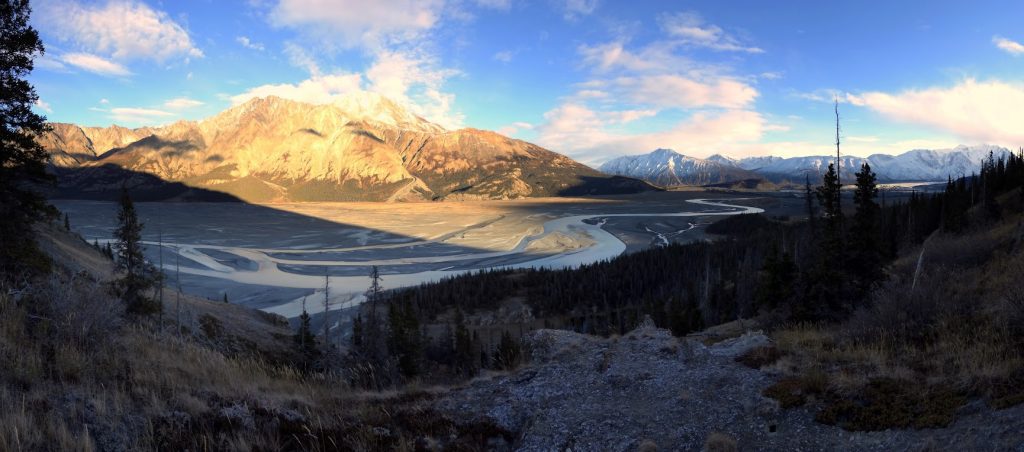
I made it to the camping area in the light of alpenglow, and decided to camp on a gravel stretch of the river bank with easy access to water from one of the river braids instead of inside the trees. I figured that way I could quickly heat some water to rehydrate some food and hunker down, instead of stumbling my way back and forth in the dark between the river and trees. By the time I finished unpacking and setting up my tent, it was already dark. I scarfed down a portion of rehydrated food, and made preparations for the night – including stowing the bear locker and its food and toiletries contents a good distance away from the tent. It was an exhausting day but I had made it, I might even see the aurora borealis and set an alarm for the time it was supposed to appear (based on the aurora forecast).
Except when the alarm rang, I woke up frozen, literally. Temperature had dropped dramatically and the tent poles threatening to snap under howling katabatic winds, gravity-driven winds carrying cold air off the ice cap and glacier that were funneling down the valley. I had to move or I would succumb to hypothermia. I huddled the sleeping bag and myself into a ball to conserve body heat, listening and hoping for a a break in the katabatic winds. The lulls were intermittent, the winds would pick up a few minutes after, sometimes it would be 10 to 15 minutes before the winds picked up. Once I mapped out the rough pattern, I began timing the length of the lulls; 2 minutes, no good, 1 minute, no good. During one of the lulls, the wind still had not picked up at the 5 minute mark, I decided to bet on it being a longer lull. By the 6 minute mark, I got out of my tent to move camp. The clouds were low and swirling above me, I wasn’t going to see any auroras that night. I was shivering, my hands frozen into claws, I was not going to be able to pack things up; so I tossed everything into the backpack and the tent , hoisted the backpack on one shoulder and used my hand claws to drag the entire tent and its contents a few hundred feet across the riverbed to where the tall riverbank offered some shelter from the winds.
The katabatic winds picked up again when I reached the riverbank and I quickly shed the backpack and crawled into the tent and sleeping bag. I was tired and cold and just wanted to sleep. I quickly dozed off for an indeterminable period of time before I bolted awake, alarm bells ringing in my head. There were some things that did not seem quite right in the area I had set up an impromptu camp. Perhaps it was the way the tread of the ground seemed different under my headlamp, or the way the sparse vegetation bent, all little signs that did not stand out nor immediately register as I was scrambling for shelter from the winds. But now they registered, I had inadvertently camped on an animal trail leading to the river. Shit. I would be in the path of a grizzly ambling for an early dawn drink, and the position of the tent under the tall river bank to shield it from the winds meant that neither of us would have any warning of the other’s presence until they were on top of me. A startled grizzly is not a good thing.
Again I counted the lulls between the howling winds, and during a break I hastily hoisted and dragged everything up the riverbank into the trees at a safe distance. It was around 5am, I had not gotten much sleep and quickly drifted into peaceful slumber. I slowly awoke to that same drifting feeling, it took a while in my half awake state to register that soft feeling was the sound of falling snow. I opened my eyes and saw the tent about to collapse, the tent poles were bending under the weight of the accumulated snow. It was around 11am and must have been snowing for hours. My boots outside the tent were buried in the snow, I got out of the tent, brushed away the accumulated snow and tightened the guylines to help the falling snow slide off the tent. I hunkered down in the tent and knew I was in trouble; I was still shivering uncontrollably and my breathing was labored, I had stumbled around getting the snow off the tent and fumbled with the guylines for a long time. I recognized the early stages of hypothermia. I had to get my core temperature up somehow, the tent and sleeping bag were not enough. I had to fight the urge to just let it go and doze off to the dreamy drift of falling snow.
Deciding on my course of action, I got out of the tent, located where I stashe the bear barrel and dragged it, and my backpack under the tent vestibule. I got out my camping stove, scooped snow into a pot and brought it to a boil. You are not supposed to cook under a tent vestibule due to fire and suffocation hazards, but desperate times calls for desperate measures. I began making and consuming all the hot food I had on hand, mainly instant noodles and dehydrated meals, to try to raise my body temperature and provide fuel to maintain it. I had originally planned to spend a few days in the area exploring, such as climbing Observation mountain to an overlook of Kaskawulsh glacier but that was no longer going to happen due to the snow, my sluggish body, and my consuming 3 days worth of rations to stave off hypothermia.
At around 3pm the snow had stopped falling and the sun was shining, my plan had worked I was no longer shivering and could feel my hands and toes. I decided I would try to hike towards the toe of Kaskawulsh glacier and see how far I could get. It looked like an easy flat expanse from the riverbank but the scale of the mountains plays tricks on sense of perspective. What looked like a flat easy walk from afar turned out to be crisscrossed by side streams coming down from the mountainsides, thankfully they were relatively easy to cross as the recent cold snap had reduced their flow, some braids were still iced over. There was a series of four terminal morraines left behind at as the glacier retreated, to climb and scout a way across. Nestled in depressions along the top of the morraines were patches of low berry plants, struggling to gain a foothold in the barren ground of glacial rocks and silt. I felt an affinity for those plant.
I kept on going until I reached the edge of a glacial lake that impeded further progress. Across the lake I could see the collapsed toe of the Kaskawulsh glacier, and I had a glimpse of an adjoining Kaskawulsh river valley also terminated at the glacier. I did not realize then how fleeting that was. In less than 4 years that lake would no longer exist and the A´ąy Chù river would dry up in a matter of days. For more than a century, the toe of the Kaskawulsh glacier pushed up against a rock hill, its meltwater fed two glacial lakes that spilled over into two different rivers. Most of the fresh water flowed north into A´ąy Chù which is the major water source for Kluane Lake. Water from Kluane lake feeds the Kluane River, and eventually flows into the Yukon River for its final journey to the Bering Sea. As the Kaskawulsh glacier receded, it pulled back just enough from the rock hill that a narrow channel opened through the ice between the two glacial lakes; the higher lake (the one whose banks I stood on) drained into the lower, directing the entire meltwater flow first east to the Kaskawulsh river, and eventually south toward the Pacific Ocean. On my second trip to the Yukon for GONE DYKE, I stopped again at Kluane Lake. Robbed of its primary water source from the A´ąy Chù river, its water levels had dropped, the river delta is mostly dry and winds gusting through the valley blow up glacial silt from the dry riverbed.
I hiked out the next morning ahead of schedule. as I had consumed most of my provisions and fuel to stave off hypothermia. I was feeling rather optimistic, having risen above a number of close calls. The weather had passed and the sun was shining. About halfway up the inclined crack which ran along the cliff face that led to the top of the ridge, I noticed a set of grizzly tracks and scat on my path. I had encountered grizzly tracks and scat fairly regularly during my hike in, but this one looked particularly fresh. I looked up ahead towards the top of the ridge I was heading towards and my heart sank – up ahead peering through the foliage was the tall hunched brown shoulder of a grizzly straddling the trail. It was so large that I could only see its shoulder that loomed above the gap in the shrubs beside the trail, its head and rest of the body were obscured by the foliage. I held my breath and stopped in my tracks in an awkward frozen lunge to balance on the upwards incline. The grizzly did not move, it was apparently gazing out at the sunlit valley below from the top of the ridge. My hands reached feverishly for bear spray as quietly as possible, which had dangled away to the back of the pack due to the incline, as I weighed my options. The usual bear encounter strategies were not feasible given my situation; I could not take a detour, bound by a cliff wall to my left and a steep drop to my right. Turning back was also not an option, that would mean turning my back to the grizzly and I would be in its path of descent. After the umpteenth desperate fumble, my hand finally grasped the bear spray and I detached it from the loop, removed the safety, and held it in front of me. Using the spray was also not an option given the incline, the spray would definitely blow back towards me. No, I held the bear spray as a last resort if the grizzly decided to descend towards me.
I decided the only viable way was to vocalize to alert the grizzly of my presence but not startle it, and somehow communicate I was not a threat but also not a prey. To coax it to move away from its spot, but not move away towards me. All very contradictory so I improvised a weird vocalisation that strung together ahems, hmms, and uh huhs into a composite call that swooped down (because I thought that might sound assertive) and terminated with an upwards scoop like a question (because I thought that would me seem less of a threat). My first vocalization was hesitant, my throat was dry and I was breathing rapidly. I gulped down saliva and breaths and tried again “ah-hem-mmmmmm-uuuh-huh”, no response. Not sure if that was a good or bad thing so I tried again and again and again, each time varying the intonation and volume.
Finally the grizzly moved after 15 minutes or so, I saw the rest of its body emerge from the foliage as it turned away and headed into the forest away from the cliff edge. However due to the foliage cover from my perspective, I could not tell if the grizzly had indeed moved on, or was just chilling by the side of the trail at the top of the ridge. My knees were shaking as I slowly climbed up the rest of the way to the top of the ridge, like Inspector Closseau from the Pink Panther movies – bear spray aimed nervously in front of me, and my shaky legs takng deliberate cautious creeping steps forward. It took my about half an hour at that pace to reach the top of the ridge and I was relieved to see no grizzly was waiting for me. I leaned against a tree, and guzzled copious water for my parched throat.
There was no way of telling if that grizzly or another was ahead of me in the forested stretches of the trail. So I decided the best thing was to sing continuously for the remaining 22km somehow, to give any grizzlies ahead of me an early warning to hopefully move away. I ended up picking the Casta Diva aria from Bellini’s opera Norma; it has long sustained legato phrases that will carry, and ends in a series of high notes I could screech out for added volume. As I progressed, the high notes became lower and lower, and the legato lines became gaspy and hoarse but still I perservered. This experience later became the idea for my endurance operatic performance installation DEALT.
I was exhausted by the time I had crossed the last glacial fan. Though it was somewhat easier going on the way back since I had a rough sense of where I began on the other side and barelled across in the general direction. I still got lost trying to find the connection back on route, but I did not have to constantly retrace my steps. The adrenaline rush from the grizzly encounter which propelled me forward had run its course, and I was crashing and experiencing extreme fatigue from withdrawal; plus having to sing Casta Diva throughout did not help matters. I was unsure if I could make it out the rest of the way on the same day, and recalled passing a small sand beach between the marshes and the mud around the halfway mark and decided to make camp there, and hike out the next day. Except when I reached the small sand beach, there was a freshly killed elk carcass that was not there on my way in which occupied the viable camping area. I quickly pushed on, it was a fresh kill and was sure to attract other predators.
Trudging across the marshes was boot-sucking and soul-sucking, I was tired so progress was slow and miserable. It was evening by the time I reached the stream crossings. With fresh snow pack plus an afternoon of snowmelt, the streams had engorged into deep, fast rivers with water so cold my foot went numb when I put it in. This was bad, with numb feet I would not be able to feel the bottom and likely to lose my balance crossing the river. I spend over an hour scouting upstream and downstream, looking for the safest way to cross. I could not find any, and eventually picked one after weighing the relative risks of different potential crossing routes. My feet and legs went numb as soon as I stepped in; I probed for the next step with a hiking pole, moved my leg in position, leaned forward to bear some weight down to check if my feet were stepping on something solid before moving the other leg. Back on dry land, my feet and legs were seized by excruciating fiery pins and needles as circulation returned.
It was around 6pm and starting to get dark when I reached the car. In my original itinerary, I had booked a stay at a nearby lodge on Kluane lake for the next day (figuring I would be too tired to drive to the next town). Since I was getting out a day early and had no way of contacting the lodge, I decided to drive there to see if they had any vacancies for the night. The lodge was located at the end of a long gravel road past Silver City, an abandoned mining town. Ambling past the ruins of shadowed collapsed houses at dusk was not unsettling at all, it was also not unsettling to eventually arrive at the lodge to find it lit but locked and devoid of life. I called out a few times and knocked on various doors, still no dice. I walked back to the car and looked out over the lake, pondering what I should do next when I heard the sound of tires on gravel behind me. I turned and saw a dazzlingly handsome RCMP officer get out of his vehicle and walk towards me. “What are you doing here?” he asked. The thought that ran through my mind was, this was either a perfect setup for a horror-slasher flick, or an erotic gay porno. I explained I just got off the trail and was looking to see if they had any vacancies for the night. “You have to leave,” he said. The RCMP were looking for “a dangerous man” (his words) and had evacuated the lodge and the surrounnding areas for their manhunt.
I got into my car, laughed ruefully at my luck, pushed through my exhaustion and drove to the next town where I managed to find a motel that was still open. The next morning, I decided to head to Skagway, Alaska and drove off with the dawn rising on the snow-peaked massifs of the St. Elias range reflected in my rear-view mirror. Reflecting on my travels and my travails, the first two stanzas of a song poured out.
Could I rejoin the human race?
Now that I think I’ve found my way.
My footsteps are weary, the burdens I carry;
I had a long way to go.Would I rejoin the human race?
from “Could I Rejoin” from Loon Songs (Stephen Chen)
Might this soul’s yearning be erased?
I dwelt in pure Beauty, I pondered life’s Mystery;
What lies ahead I don’t know.
I was not sure how to continue or end it, and tried different options – none of which felt right. Passing through Whitehorse, my phone began beeping as it entered signal range caught up on missed notifications and messages. I decided to stop for lunch and catch up on my messages. Bob had left me a voicemail informing Annie had passed away; she was my glaucoma buddy and bunny, and we would take the glaucoma eyedrops together. I had lost Socksy during the earlier trip to the West coast and that pain was still fresh. Instead of heading straight to Alaska after Whitehorse, I took a detour to a lesser-known lake that I remembered seeing in the maps. I parked my car on the stretch of gravel road that overlooked Annie Lake and gazed at it, no words, no purpose, no gesture, before doing a 3-point -turn and continued my journey.
wrestling the absence
Blank (Futile Overtures)
of reason whatsoever
for feeling so sad
Skagway, Alaska was similarly shut down for the season, there was one bed and breakfast still open which I managed to secure a room for the night. With the cruise ship passengers long gone, it took on the appearance of a ghost town; all the shops with their “frontier” facades were closed or boarded up. I managed to find a restaurant that was still open (that day was actually its last day). The mountain pass connecting Skagway and the Yukon was obscured with rain and thick cloud on the drive to and from Skagway. But on the way back, the cloud cover broke when I reached the top of White Pass, (which was one of the routes into the Klondike during the gold rush) after leaving Skagway and I glimpsed the Tormented Valley; a harsh landscape I had never seen before of fractured rock islands dotted with lichen and centuries-old pine trees stunted by the harsh conditions and winds, bound by snowed-in peaks of White Pass. It called to me and would plant the seeds for my return a few years later to hike/perform GONE DYKE. And it made me realize the ending of my song.
Should I rejoin the human race?
from “Could I Rejoin” from Loon Songs (Stephen Chen)
Or drift with wind without a trace?
<< CRATERING – BASIN II | GEOLOGY OF HEARTBREAK | CRATERING – EJECTA II >>