
Atomic Memory Auditor operates at the intersection of archival reconstruction and moral repair. It is both an instrument and an argument: an evidence-based counter-memory engine built from fragments of text, testimony, and institutional record. Its Retrieval-Augmented Generation (RAG) corpus replaces the usual foundation model’s compliance with official narratives—those polished histories produced by states, museums, and media—with a foundation of dissonant, recovered memory.
Each document integrated into this corpus acts as a site of resistance. The pipeline is not a neutral data process but a historical intervention: retrieval becomes excavation, generation becomes re-articulation. Instead of recombining learned generalities, Atomic Memory Auditor draws language from a living archive shaped by user-curated evidence. It learns not from the machinery of consensus, but from the sediment of contested histories. In technical terms, the RAG pipeline retrieves fragments from this critical corpus and generates language through their friction. But as method, it performs an ethical act: retrieval as recovery, generation as resistance. The system does not seek coherence with dominant archives — it seeks dissonance with them. Every generation event becomes a negotiation between memory and ideology, between what is documented and what has been silenced.
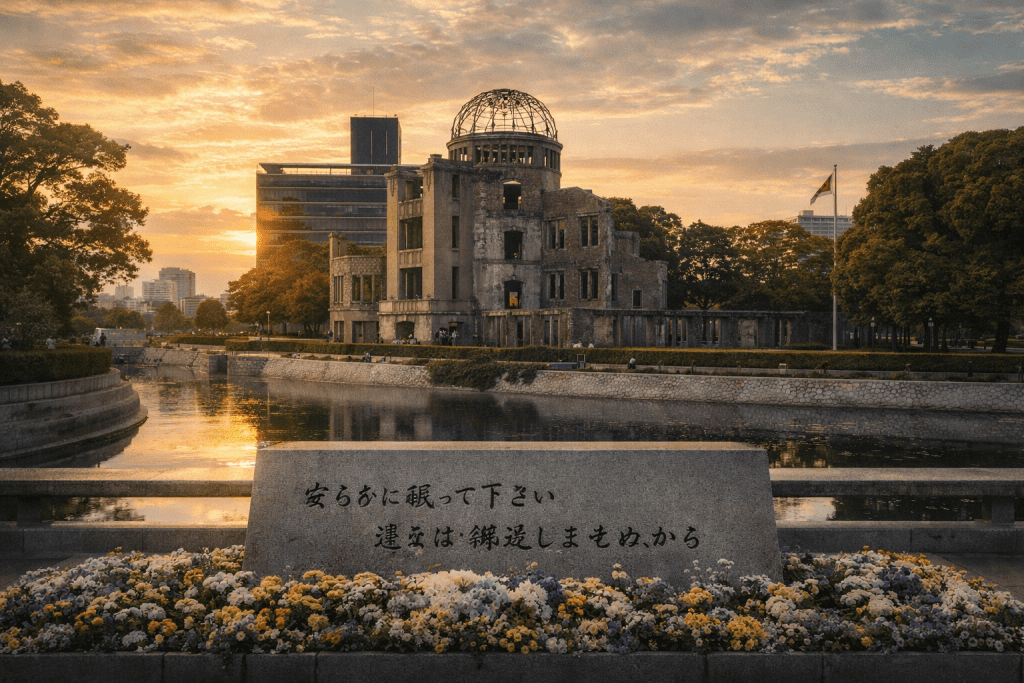
In the shadow of Hiroshima and Nagasaki, this system confronts the machinery of forgetting—how remembrance is curated to preserve national innocence. It resists sentimental closure by constantly re-inserting context: Japan’s imperial violence, the human cost of occupation, the global complicity that allowed such narratives to calcify. The RAG pipeline, in this sense, is a moral infrastructure: a recursive act of retrieval against erasure. The project situates itself within the ethics of remembrance. It treats data not as resource but as responsibility — a trace of human suffering, complicity, or denial. To retrieve is not to recall but to reopen. By grounding itself in a corpus of contested histories — Hiroshima and Nagasaki, the Asia-Pacific War, the moral afterlives of empire — Atomic Memory Auditor functions as both machine and mirror: it audits the systems that produce historical innocence, including those built into AI itself.
To engage with Atomic Memory Auditor is to participate in this ongoing process of critical remembering. The model does not merely “answer” questions—it audits memory, tracing how facts become myths, and how myths become identities. Its archive grows not through compliance, but through contribution; every new document, every recovered fragment, extends the field of resistance.
In an era of machine-trained consensus, Atomic Memory Auditor offers a different intelligence—one grounded in evidence, dissonance, and the refusal to forget. Where conventional machine learning smooths difference into probability, Atomic Memory Auditor reintroduces tension. It resists the homogenizing logic of statistical consensus that defines most AI outputs — the automation of public forgetting. Its architecture reimagines machine intelligence as a form of archival activism, an epistemic stance that privileges evidence over optimization, testimony over training data.
Through this architecture, the work asks: what would it mean for machine memory to resist rather than reproduce power? How might retrieval become a form of moral repair? And can generation, when grounded in witness rather than noise, restore the capacity to remember differently?
